Temporomandibular joint TMJ disorders affect tens of millions of people and produce some of the most disruptive and difficult-to-diagnose pain conditions in dental medicine. The jaw joint and surrounding jaw muscles are involved in virtually every movement of daily life, from eating and talking to yawning and swallowing, which means that TMJ pain affects function in ways most other joint disorders simply do not. The good news is that the majority of temporomandibular disorders respond well to treatment, and most patients can achieve significant pain relief and restored jaw movement without ever needing surgery. Understanding the full range of TMJ treatment options, from conservative self care to minimally invasive procedures and orthodontic treatment, is the foundation of making an informed decision about your care.
What Are TMJ Disorders?
TMJ disorders, also called temporomandibular disorders or TMD, are a group of conditions that cause pain and dysfunction in the temporomandibular joint and the jaw muscles that control jaw movement. The temporomandibular joint TMJ connects the lower jaw to the temporal bone of the skull and is one of the most constantly used joints in the human body. When this joint or the surrounding tissues are affected by inflammation, misalignment, muscle tension, or structural damage, the result is a range of TMJ symptoms that can include jaw pain, facial pain, ear pain, persistent headaches, difficulty chewing, and locking or restricted jaw movement.
The etiology of TMJ disorders is multifactorial, including biological, environmental, social, emotional, and cognitive triggers. Common causes of temporomandibular disorders include teeth grinding, teeth clenching, jaw clenching, bite misalignment, arthritis, jaw injury, nail biting, gum chewing, and psychological stress. Factors consistently associated with TMJ disorders include other pain conditions such as fibromyalgia, autoimmune disorders, sleep apnea, and psychiatric conditions including depression and anxiety. Accurate diagnosis is the critical first step because TMD symptoms overlap significantly with other orofacial pain and pain conditions, and treating the wrong root cause produces no relief.
Common Symptoms of TMJ Disorders
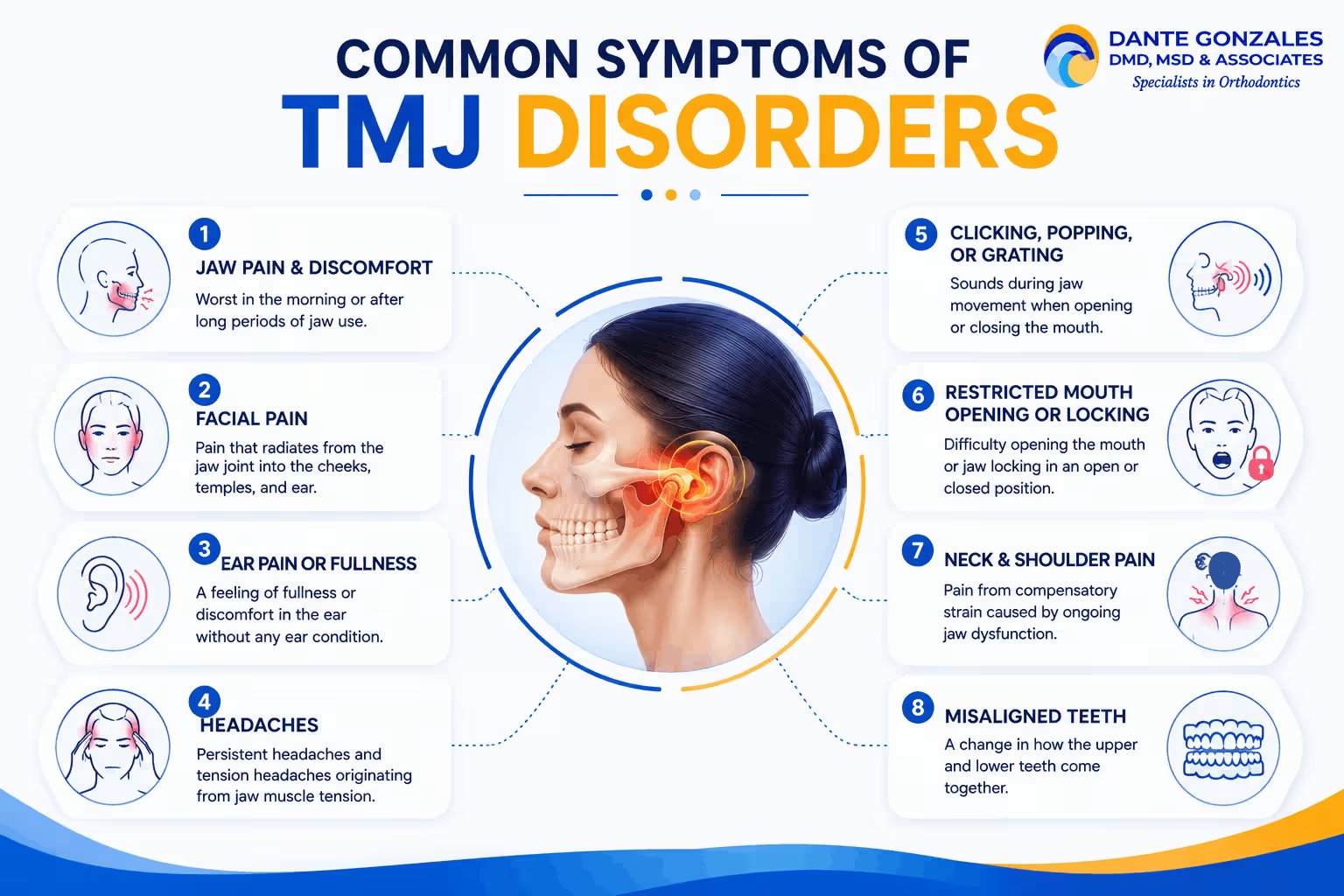
Before exploring treatment options, understanding what TMJ disorders feel like helps patients recognize when their symptoms warrant professional evaluation. Common symptoms of temporomandibular joint dysfunction include:
- Jaw pain and jaw discomfort that is worst in the morning or after long periods of jaw use
- Facial pain and orofacial pain that radiates from the jaw joint into the cheeks, temples, and ear
- Ear pain or a sensation of fullness in the ear without any identifiable ear condition
- Persistent headaches and tension headaches originating from jaw muscle tension
- Clicking, popping, or grating sounds during jaw movement when opening or closing the mouth
- Restricted mouth opening or locking of the jaw in an open or closed position
- Neck muscles pain and shoulder pain from the compensatory strain generated by ongoing jaw dysfunction
- Misaligned teeth or a change in how the upper and lower teeth come together
TMD symptoms can vary considerably in severity. Mild discomfort that comes and goes with stress or overuse is very different from severe pain that is constant, limits mouth opening, and interferes with eating and sleeping. Understanding the severity and pattern of your specific TMJ symptoms helps your healthcare provider determine which treatment tier is most appropriate and how urgently treatment is needed.
TMJ Treatment Options: A Complete Overview
Treatment options for temporomandibular joint TMJ disorders are generally organized into three tiers: non-invasive conservative treatments, minimally invasive procedures, and surgical interventions. The TMJ Association and clinical guidelines consistently recommend starting with the most conservative, reversible treatments before advancing to more invasive options. The table below summarizes all major TMJ treatment options across each tier:
| Treatment Option | Invasiveness | Best For | How It Works |
|---|---|---|---|
| Self-Care and Lifestyle | Non-invasive | Mild TMJ symptoms | Soft foods, moist heat, jaw rest, good posture, relaxation techniques |
| Oral Appliances | Non-invasive | Mild to moderate TMJ | Night guards, occlusal splints prevent teeth grinding and jaw clenching |
| Medications (NSAIDs) | Non-invasive | Acute pain flare-ups | Nonsteroidal anti-inflammatory drugs, muscle relaxants, low-dose antidepressants |
| Physical Therapy | Non-invasive | Muscle-driven TMJ pain | Jaw exercises, manual therapy, transcutaneous electrical nerve stimulation (TENS) |
| Botox Injections | Minimally invasive | Moderate TMJ, bruxism | Injecting botulinum toxin type A into masseter and temporalis muscles |
| Trigger Point Injections | Minimally invasive | Myofascial TMJ pain | Corticosteroid or anesthetic injections into painful jaw muscle trigger points |
| Orthodontic Treatment | Non-surgical | Bite misalignment-related TMJ | Corrects misaligned teeth and jaw positioning driving TMJ dysfunction |
| Arthrocentesis | Minimally invasive | Moderate structural TMJ | Needle injection to flush the temporomandibular joint and reduce inflammation |
| Arthroscopy | Surgical | Moderate to severe TMJ | Tiny camera inserted into jaw joint to remove adhesions or reposition disc |
| Open Joint Surgery | Surgical | Severe structural TMJ | Last resort for severe pain and joint degeneration unresponsive to other treatments |
Tier 1: Conservative and Non-Invasive TMJ Treatments
The vast majority of TMJ disorders respond to conservative treatments that do not involve surgery or permanent alteration of the jaw joint or teeth. Managing TMJ symptoms typically begins with these non-invasive approaches, which are effective for most patients with mild to moderate temporomandibular disorders. Non-invasive and conservative treatments are the first line of defense for TMJ disorders, as recommended by the National Institutes of Health.
Self-Care and Lifestyle Modifications
Simple daily adjustments can significantly reduce strain on the jaw joint and masticatory muscles for patients with mild or periodic TMJ symptoms. Eating soft foods and avoiding hard foods, raw vegetables, and chewy items reduces the mechanical load on the jaw joint during active flare-ups. Avoiding gum chewing and nail biting eliminates overuse habits that cause jaw muscle spasm. Applying moist heat to relax tight jaw muscles or an ice pack to reduce acute pain and swelling are effective self care strategies that ease pain and reduce discomfort between professional treatments.
Good posture throughout the day, particularly avoiding forward head position at a desk or during device use, reduces the strain on the neck muscles and jaw joint that drives tension headaches and persistent TMJ pain. Resting the jaw with teeth slightly apart and lips together, rather than clenching the teeth together, is the correct resting jaw posture that reduces unnecessary jaw muscle tension throughout the day.
Oral Appliances: Night Guards and Occlusal Splints
Oral appliances are among the most widely used and clinically supported non-invasive treatments for temporomandibular disorders. Custom-fitted night guards and occlusal splints prevent teeth grinding and teeth clenching during sleep, reducing the unnatural forces placed on the temporomandibular joint and jaw muscles overnight. These medical devices keep the jaw joint in a neutral, decompressed position during sleep, reducing jaw muscle tension, jaw pain, and the morning symptoms that define many patients' daily TMJ experience.
Intraoral appliances such as night guards and splints are commonly used to alleviate TMD symptoms, and while the evidence on their long-term effectiveness varies, most patients experience meaningful reduction in jaw pain and headache frequency with consistent nightly use. Oral appliances are most effective when combined with other conservative treatments addressing the behavioral and muscular components of TMJ dysfunction simultaneously.
Medications for TMJ Pain Relief
Medication is generally used short-term to manage acute pain and inflammation in patients with TMJ disorders rather than as a long-term standalone solution. The most commonly used medications for TMJ pain relief include:
- Nonsteroidal anti-inflammatory drugs (NSAIDs): Over-the-counter nonsteroidal anti-inflammatory drugs such as ibuprofen are the first-line agents for the initial treatment of acute pain associated with TMJ disorders, typically prescribed or recommended for 10 to 14 days to reduce joint swelling and relieve pain
- Muscle relaxants: Prescribed alongside NSAIDs when there is a muscular component to the TMJ disorder, muscle relaxants help alleviate jaw muscle spasm, ongoing pain, and jaw discomfort
- Over-the-counter medications: Over the counter medications including acetaminophen provide mild discomfort relief for patients with less severe TMJ pain conditions who do not require prescription-strength anti-inflammatory treatment
- Low-dose antidepressants: Tricyclic antidepressants such as amitriptyline are used for managing chronic TMJ pain, particularly when other treatments have not been effective, by interrupting the central pain sensitization that drives persistent symptoms
- Corticosteroid injections: Injected directly into the jaw joint to relieve acute inflammation and provide temporary pain relief during severe TMJ flare-ups
Physical Therapy for TMJ Disorders
Physical therapy is one of the most effective non-invasive treatment options for TMJ disorders with a significant muscular component. A physical therapist designs a personalized program of jaw exercises, manual therapy, and postural correction that addresses the specific jaw muscle tension and jaw movement restrictions driving the patient's TMJ symptoms. Physical therapy can improve joint mobility, relieve pain, and restore normal jaw movement in patients whose temporomandibular joint dysfunction is driven primarily by muscular imbalance and poor posture patterns.
Specific jaw exercises used in physical therapy for TMJ disorders include:
- Relaxed jaw exercise: Gently opening and closing the mouth while keeping teeth apart and tongue on the roof of the mouth to reduce jaw muscle tension
- Goldfish exercises (partial opening): Partially opening and closing the mouth to increase range of motion flexibility and decrease TMJ stiffness
- Chin tucks: Tucking the chin toward the chest to improve posture and relieve tension in the neck muscles and jaw
- Resisted mouth opening: Placing resistance under the chin while opening the mouth to strengthen jaw muscles and improve jaw joint stability
- Side-to-side jaw movement: Stretching the muscles that support the temporomandibular joint to improve mobility and reduce jaw discomfort
Transcutaneous electrical nerve stimulation (TENS) and acupuncture are complementary treatments used alongside physical therapy that have been studied for their potential benefits in managing TMD symptoms and reducing orofacial pain. Relaxation techniques, cognitive behavioral therapy, and biofeedback are self-management strategies that address the psychological causes of TMJ disorders including stress, anxiety, and subconscious jaw clenching.
Tier 2: Minimally Invasive TMJ Treatments
When conservative treatments do not adequately relieve TMJ pain or persistent symptoms return despite consistent self care and oral appliance use, minimally invasive procedures are the next appropriate step. These treatments address more specific structural or muscular root causes of TMJ disorders without the risks and recovery associated with open joint surgery.
Botox Injections for TMJ
Injecting botulinum toxin type A into the masseter and temporalis jaw muscles is one of the most effective minimally invasive treatments for TMJ disorders driven by chronic jaw clenching, teeth grinding, and jaw muscle tension. Botox works by temporarily blocking nerve signals to the overactive jaw muscles, reducing muscle contraction force and relieving the TMJ pain, headaches, and jaw discomfort that muscular overactivity generates. The effects of Botox for TMJ typically last 3 to 4 months, after which repeat treatments maintain ongoing pain relief.
Botox injections are particularly valuable for patients with significant bruxism, enlarged masseter muscles, and treatment-resistant jaw muscle tension that has not responded to oral appliances or physical therapy alone. Botulinum toxin type A has been studied extensively for its potential to relieve TMJ pain by relaxing jaw muscles, and while it is classified as an off-label treatment by the FDA specifically for TMJ disorders, it is widely used and clinically supported as part of a comprehensive TMJ treatment plan.
Trigger Point Injections
Trigger point injections deliver corticosteroids or local anesthetic directly into specific painful points within the jaw muscles and neck muscles that are generating referred TMJ pain. These injections relax the muscle fibers at the trigger point, interrupt the pain cycle, and provide direct pain relief in cases where myofascial pain is a primary contributor to the patient's TMJ symptoms. Trigger point injections are typically used alongside physical therapy and other conservative treatments rather than as a standalone TMJ treatment option.
Arthrocentesis
Arthrocentesis is a minimally invasive procedure that involves using a needle to inject liquid into the temporomandibular joint to flush out inflammatory byproducts, remove scar-like tissue, and reduce inflammation within the jaw joint. It is typically performed under local anesthesia as an in-office procedure and provides temporary pain relief and improved mouth opening for patients with moderate structural TMJ involvement that has not responded to nonsurgical treatments. Arthrocentesis is considerably less invasive than arthroscopy or open joint surgery and is often the first procedural intervention considered when conservative treatments are insufficient.
Tier 3: Surgical TMJ Treatments
Surgical options for TMJ disorders are a last resort, reserved for patients with severe pain, significant structural joint degradation, and confirmed failure of conservative and minimally invasive treatments. Invasive options are considered only for severe, chronic cases that do not respond to conservative management, as recommended by the TMJ Association and clinical guidelines. The decision to involve surgery requires thorough evaluation including magnetic resonance imaging to assess the internal structures of the jaw joint before any surgical plan is developed.
Arthroscopy
Arthroscopy allows a surgeon to insert a tiny video camera into the jaw joint through a small incision to diagnose and treat structural issues directly, such as removing adhesions, repositioning the displaced articular disc, or flushing the joint. This procedure has been shown to moderately improve pain and jaw function for patients with internal derangement that has not responded to other treatments. Arthroscopy is significantly less invasive than open joint surgery, carries fewer risks, and requires a shorter recovery period.
Open Joint Surgery
Open joint surgery is the most invasive TMJ treatment option and is reserved for severe structural joint degradation that cannot be addressed through arthroscopy or other procedures. Surgical treatments for TMJ disorders include arthroscopy, open joint surgery, and orthognathic surgery to realign jaws. In the most severe cases of joint destruction, total joint replacement using TMJ implants may be considered, though concerns about long-term safety and efficacy mean this option is approached with significant caution and used only when all other options have been exhausted. Any decision to involve surgery for TMJ disorders should involve consultation with an oral and maxillofacial surgeon alongside the patient's existing dental and medical healthcare providers.
The Role of Orthodontic Treatment in TMJ Management
For patients whose temporomandibular joint pain and dysfunction has a bite alignment component, orthodontic treatment plays a clinically meaningful role in comprehensive TMJ management. Misaligned teeth create uneven distribution of bite forces across the jaw joint and jaw muscles, placing chronic, disproportionate stress on the temporomandibular joint that contributes to TMJ pain, jaw muscle tension, and progressive joint wear over time.
Correcting misaligned teeth through Invisalign or other orthodontic treatment eliminates this source of structural TMJ stress, reducing the forces on the jaw joint that drive ongoing pain and dysfunction. At Dante Gonzales Orthodontics, orthodontic treatment for TMJ-related bite misalignment is evaluated as part of a comprehensive assessment that considers the full pattern of the patient's TMJ symptoms, treatment history, and jaw anatomy. Orthodontic treatment is not a standalone solution for all forms of TMJ disorders, but for patients with a clear bite misalignment component, it is an important and lasting part of the overall treatment plan.
When Is TMJ Serious? Knowing When to Seek Help
Most mild or short-term TMJ issues respond well to conservative, reversible habits and self care. However, certain patterns of TMJ symptoms indicate a more serious condition that requires prompt professional evaluation:
- Jaw locking that prevents full opening or closing of the mouth
- Severe pain that does not respond to over-the-counter medications or self care
- Persistent symptoms that worsen over weeks despite conservative management
- Significant changes in bite alignment or the way the upper and lower teeth come together
- TMJ pain accompanied by facial swelling, fever, or neurological symptoms
Early treatment is consistently associated with better outcomes in temporomandibular disorders. The longer significant TMJ pain and dysfunction goes unaddressed, the more complex the underlying joint and muscle changes become, and the less likely conservative treatments are to provide complete relief. If your TMJ symptoms are interfering with eating, sleeping, or daily function, a comprehensive evaluation by a TMJ specialist or orthodontist experienced in orofacial pain is the most important step you can take.
How to Make TMJ Go Away Faster: Key Principles
While there is no single permanent cure for all forms of TMJ disorders, most patients achieve significant and lasting pain relief by following these core principles of effective TMJ management:
- Start with conservative treatments and give them sufficient time before moving to more invasive options
- Address the root causes, not just the symptoms — whether that means stress reduction, bite correction, or physical therapy for jaw muscle tension
- Be consistent with self care strategies including soft foods, jaw rest, good posture, and relaxation techniques every day
- Wear oral appliances as directed every night without exception to protect the jaw joint from nighttime grinding and clenching
- Communicate openly with your healthcare provider about what is working, what is not, and any changes in your TMJ symptoms
- Seek accurate diagnosis early rather than waiting for symptoms to become severe before pursuing evaluation and treatment
Comprehensive TMJ Care at Dante Gonzales Orthodontics
If TMJ pain, jaw joint dysfunction, or persistent orofacial pain has been affecting your daily life and you have not been able to find lasting relief, Dante Gonzales Orthodontics provides comprehensive evaluation and treatment for patients whose temporomandibular disorders have a bite alignment or orthodontic component. We assess the full clinical picture before making any treatment recommendation, and we coordinate with your existing healthcare providers to ensure your TMJ care is integrated, not fragmented.
Comprehensive TMJ and Bite Evaluation: We use advanced digital imaging, magnetic resonance imaging referral when indicated, and a thorough clinical examination of the temporomandibular joint, jaw muscles, and bite alignment to identify the specific root causes driving your TMJ symptoms and determine which treatment options are most appropriate for your case.
Orthodontic Treatment for Bite-Related TMJ: For patients whose TMJ disorders have a clear bite misalignment component, we design a personalized orthodontic treatment plan using Invisalign or other appliances to correct misaligned teeth and relieve the uneven jaw joint forces driving persistent TMJ pain and jaw discomfort.
Collaborative, Patient-Centered TMJ Care: We work alongside physical therapists, pain specialists, and oral surgeons to ensure your TMJ treatment addresses every contributing factor, giving you the most complete and lasting relief from the full spectrum of your temporomandibular disorder symptoms.
Whether you are just beginning to explore TMJ treatment options or have been managing persistent symptoms without finding lasting relief, Dante Gonzales Orthodontics in Dublin and Tracy, CA is here to help you understand your options and build a treatment plan that works.